

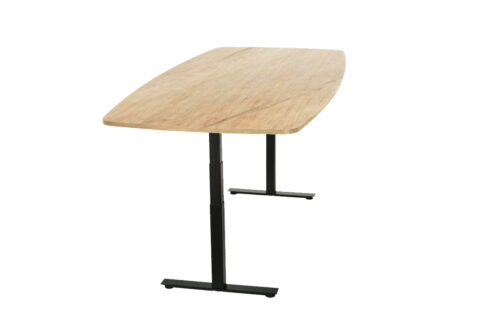
Stationary Meeting Tables With Semi-Oval Leaf Tops

Stationary conference tables with semi-oval leaf tops combine a distinctive tabletop outline with the absence of a mobility feature. This makes the relationship between the table and the room especially relevant: the chosen position should support everyday discussion without relying on routine relocation. Look at how the semi-oval leaf shape sits within the room, where participants approach it and which seats offer a practical view of shared information.

A useful arrangement begins with the meeting format. Some teams gather around documents, while others spend most of the session facing a presentation wall. Stationary semi-oval leaf tables should be considered in relation to those habits, rather than selected for their outline alone. Review the seating positions around the actual tabletop, preserve access behind occupied chairs and decide how the table will relate to the room’s main visual focus.

£22.55 p/m

Orient Stationary Semi-Oval Leaf Conference Tables

The semi-oval leaf outline gives orientation a particular role in room planning. Examine the actual perimeter and decide how it should face the entrance, presentation area and surrounding furniture. Avoid assuming that every orientation will produce the same seating relationships. A position that looks appealing from the doorway may leave a participant turning away from the discussion's main focus. Compare alternative directions before settling on the room arrangement. Because mobility is absent, it is useful to resolve the relationship between the tabletop and the room's focal points early, rather than expecting to turn or reposition the table for each meeting.

Distribute Attention Across the Seating

Think about how conversation will travel around the tabletop. In a discussion-led room, participants should be able to acknowledge each other without continually shifting their chairs. If a meeting has a designated facilitator, decide where that person can address the group and refer to shared material. The semi-oval leaf shape does not, by itself, establish which seat should lead the discussion. Use the actual outline and the room arrangement to make that judgment. Stationary conference tables with semi-oval leaf tops can then be assessed through the quality of the seating relationships, rather than through a decorative impression of the shape.

Protect Routes Behind Occupied Chairs

Circulation should follow the tabletop's actual outline, not an imagined boundary drawn around an empty room. Consider where chairs will be used and how someone reaches a seat once colleagues are already present. Pay particular attention to the approach from the doorway and the route toward shared room facilities. Do not use the visible floor around an unoccupied table as the only guide. Personal belongings, a chair pulled back during discussion and a person standing to present can all change the route. Plan a settled arrangement that accommodates these ordinary events without requiring the table to be moved out of the way.

Match the Layout to Repeated Meeting Tasks

List the tasks that recur during meetings and check them against the proposed table position. Passing a document, reviewing a shared drawing and turning toward a screen each create a different pattern of attention. Place nearby resources where they can be reached without breaking that pattern unnecessarily. Stationary semi-oval leaf meeting tables deserve particular care when the same room serves both presentations and conversation. Look for an orientation that supports the regular activities together. If an occasional task requires a different arrangement, consider whether the room can accommodate it through seating choices before assuming that furniture relocation will be part of the routine.

Questions About Stationary Semi-Oval Leaf Tables

Does the semi-oval leaf shape determine a head seat?

No. The outline alone does not assign meeting roles. Decide where a facilitator or presenter should sit by considering the room's focal point, participants' views and the way shared material will be used during discussion.

Can this combination suit a presentation room?

Assess the proposed seating from each participant's viewpoint. Stationary conference tables with semi-oval leaf tops need an orientation that allows practical presentation views while preserving comfortable routes to and from the seats used during regular meetings.

Does stationary mean permanently attached to the floor?

No. The absence of mobility does not establish floor attachment. Treat the table as having no mobility feature, and assess any installation details separately. Plan its normal position carefully without assuming a particular fixing method.

Compare how stationary conference tables with semi-oval leaf tops relates to chair positions and shared views in the intended room.

Explore related selections