


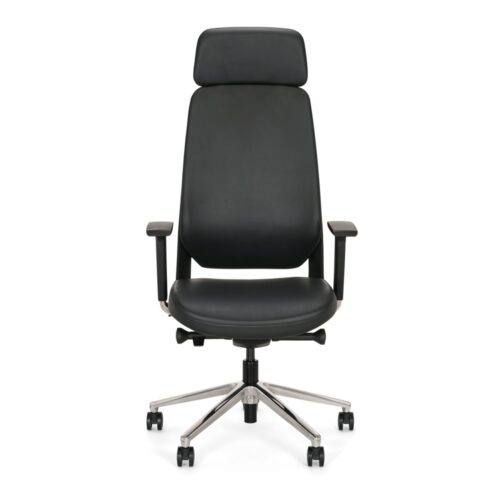
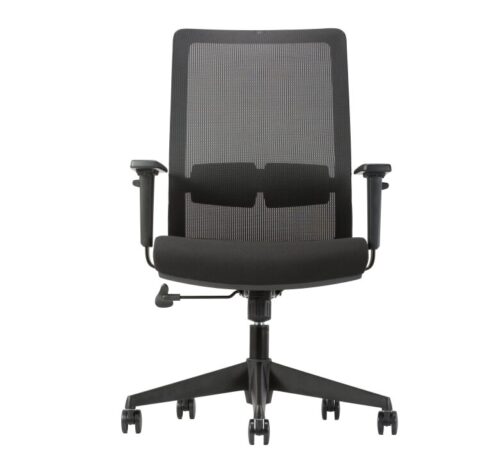
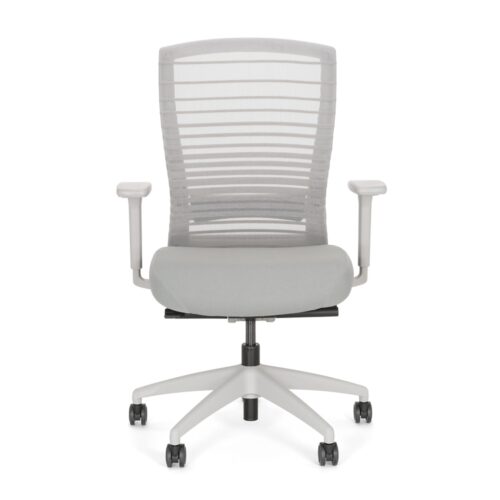
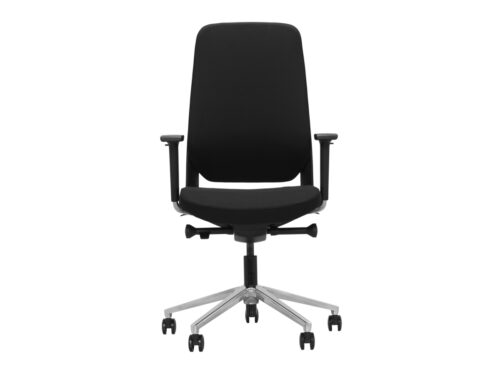
Office chairs with 4D armrests provide extensive adjustment of the arm supports, allowing users to adapt their position to different body dimensions, desk heights and working activities. A typical 4D armrest can be adjusted in four directions, such as height, width, depth and angle.
4D armrests are commonly found on highly adjustable ergonomic office chairs designed for prolonged computer work, shared workstations and hybrid offices. They provide more positioning flexibility than fixed, 1D, 2D or 3D armrests.
What are 4D armrests?
The term 4D armrests generally means that the arm supports can be adjusted in four different dimensions. A common configuration includes:
- Height adjustment – raises or lowers the armrests
- Width adjustment – moves the armrests closer to or further away from the body
- Depth adjustment – moves the arm pads forward or backward
- Angle adjustment – rotates or pivots the arm pads inward or outward
The exact definition of 4D can differ between manufacturers. Some office chairs use different combinations of movements or describe individual adjustments differently. Always check the product specification to see exactly which four adjustments are available.
Why choose an office chair with 4D armrests?
The main advantage of 4D armrests is the ability to position the arm supports more precisely for the individual user and task.
Potential benefits include:
- Greater adaptability for different body dimensions
- More precise positioning of the forearms
- Better compatibility with different desk heights
- Additional flexibility for keyboard and mouse work
- Suitable for shared and hybrid workstations
- Easier adaptation when changing working position
- A broader adjustment range than simpler armrest systems
How should 4D armrests be adjusted?
The armrests should generally provide light support beneath the forearms while allowing the shoulders to remain relaxed. They should not force the shoulders upward or prevent the user from sitting comfortably close to the desk.
Because 4D armrests offer several adjustment possibilities, it is useful to adjust them only after the basic chair position has been established.
1. Adjust the seat height
Start by setting the seat height so the user’s legs and feet are appropriately supported and the chair works with the desk height.
2. Set the seat depth
If available, use the seat-depth adjustment so the thighs are supported while the user can remain comfortably against the backrest.
3. Position the backrest
Adjust the backrest and lumbar support where these features are available.
4. Fine-tune the 4D armrests
Once the seating position is established, adjust the armrests so they support the forearms without restricting movement or interfering with the desk.
4D armrest height adjustment
Height adjustment controls how high or low the armrests sit beside the user.
The armrests should generally be high enough to provide useful support but not so high that the shoulders are pushed upward. If they are positioned too low, the user may receive little or no support from them.
The correct setting also depends on the desk. Armrests positioned too high may collide with the tabletop and prevent the chair from moving close enough to the workstation.
4D armrest width adjustment
Width adjustment changes the distance between the two armrests. This can be particularly useful because shoulder width and body dimensions vary considerably between users.
Moving the armrests inward can provide better support for narrower users, while moving them outward can create additional space for broader users.
This flexibility can make 4D armrests particularly suitable for office chairs used by multiple employees.
4D armrest depth adjustment
Depth adjustment allows the arm pads to move forward or backward.
Moving the armrests backward can help users get closer to the desk, while a more forward position may provide additional forearm support during other activities.
This adjustment is especially useful when switching between computer work, writing, meetings and different desk configurations.
4D armrest angle adjustment
Angle or pivot adjustment allows the arm pads to rotate inward or outward.
An inward position may help support the forearms during keyboard or mouse work, while a straighter or outward position may provide more freedom during other activities.
The useful range and number of available angle positions depend on the individual chair.
4D armrests for computer work
During prolonged computer work, the position of the keyboard and mouse has a significant influence on how useful the armrests are.
4D armrests can be adjusted so the forearms receive support while the input devices remain comfortably within reach. The user should not need to stretch forward or raise the shoulders to operate the keyboard and mouse.
The armrests should also allow the chair to move close enough to the desk. If the arm pads collide with the tabletop, reducing their height or moving them backward may improve the workstation setup.
Read our ergonomic workstation setup guide for more information about coordinating the chair, desk, monitor, keyboard and mouse.
4D armrests for shared and hybrid workplaces
4D armrests can be especially valuable in shared workstations because the same chair may be used by people with very different body dimensions.
Height, width, depth and angle adjustment give each employee more opportunity to reset the armrests when beginning work.
For a highly adaptable shared workstation, 4D armrests can be combined with features such as:
- Adjustable seat height
- Adjustable seat depth
- Adjustable lumbar support
- Adjustable backrest height
- A suitable synchronous or reclining mechanism
- Adjustable monitor equipment
- A height-adjustable desk
See our guide to ergonomics for shared workstations for more information about furnishing hot-desking and hybrid offices.
4D armrests vs other adjustable armrests
Not every office chair requires 4D armrests. Different levels of adjustment may be suitable depending on the workplace and intended users.
Fixed armrests
Fixed armrests cannot be repositioned. They can be suitable for meeting chairs, visitor seating and applications where extensive individual adjustment is unnecessary.
Height-adjustable armrests
Simple adjustable armrests may only move vertically. This can already provide useful flexibility for individual task chairs.
2D and 3D armrests
2D and 3D armrests provide additional adjustment dimensions beyond height. Depending on the manufacturer, these may include width, depth or rotation.
4D armrests
4D armrests provide four adjustment dimensions and are generally intended for chairs where a high level of individual adaptation is desirable.
Because terminology differs between manufacturers, compare the actual available movements rather than selecting a chair solely because it is described as 2D, 3D or 4D.
Are 4D armrests always better?
More adjustment does not automatically make an office chair more suitable. A chair with 4D armrests can provide excellent flexibility, but users also need to understand how to position them correctly.
For meeting rooms or occasional seating, four-way adjustment may provide little additional value. For a task chair used throughout the working day or shared between many employees, the additional flexibility can be much more useful.
The complete chair specification remains more important than the armrests alone.
What else should you consider when choosing an office chair?
When comparing office chairs with 4D armrests, also consider:
- Seat-height adjustment range
- Seat-depth adjustment
- Backrest dimensions and movement
- Lumbar support
- Chair mechanism
- Arm pad dimensions and material
- User weight range
- Seat and backrest materials
- Applicable office-chair standards
- Warranty and replacement-part availability
Our guide to choosing an office chair explains how these different features work together.
Questions to consider
- Which four adjustments are included in the 4D armrests?
- How large is the height-adjustment range?
- Can the armrests move inward and outward?
- Can the arm pads move forward and backward?
- How far can the arm pads rotate?
- Are the controls easy to use while seated?
- Can the chair still move close enough to the desk?
- Will the chair be assigned to one person or shared?
- Which other ergonomic adjustments does the chair provide?
Explore office chairs with 4D armrests at Myntwork
Office chairs with 4D armrests provide extensive arm-support adjustment for individual, shared and hybrid workstations. Their ability to adjust in several directions makes them particularly useful where one chair needs to accommodate different users, desk configurations and working activities.
Always compare the actual adjustment directions and the complete chair specification, as the definition of 4D armrests can differ between manufacturers.
Explore our office chairs or browse the complete Myntwork office furniture collection.
Myntwork
Myntwork
Myntwork
Myntwork
Myntwork
Myntwork
Myntwork
Myntwork
Myntwork
Myntwork
Myntwork