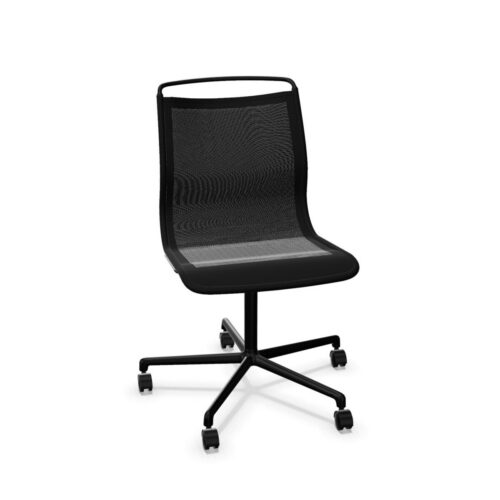


Office chairs without adjustable seat depth have a seat pan that remains at a fixed depth during normal use. The distance between the front edge of the seat and the backrest cannot be changed by the user.
A fixed seat depth can be perfectly suitable when the dimensions of the chair match the intended users. It is particularly common in meeting chairs, visitor seating and office chairs designed around a broadly suitable seat size without a separate sliding-seat mechanism.
What does “no adjustable seat depth” mean?
Seat depth describes the distance from the backrest to the front edge of the seat. On a chair without seat-depth adjustment, this distance is fixed by the design of the chair.
The user may still be able to adjust other features such as seat height, armrests, lumbar support or the reclining mechanism. Only the horizontal depth of the seat itself remains fixed.
This differs from an office chair with adjustable seat depth, where the seat pan can usually slide forward or backward to better accommodate different leg lengths.
When is a fixed seat depth suitable?
Office chairs without adjustable seat depth can work well in many professional environments, including:
- Meeting and conference rooms
- Visitor and reception areas
- Training and presentation spaces
- Executive offices
- Assigned workstations where the chair fits the regular user
- Task chairs designed to accommodate a broad user range without seat-depth adjustment
The suitability of a fixed seat depends primarily on the dimensions of the chair, the proportions of the user and how long the chair will typically be used.
Benefits of a fixed seat depth
A chair without adjustable seat depth can offer several practical advantages:
- Simple and straightforward operation
- No sliding-seat mechanism to adjust
- Consistent seating position
- Fewer moving components
- Suitable for shorter-duration seating
- Can work well when the seat dimensions already suit the intended user group
- May be appropriate where extensive individual adjustment is unnecessary
Why is seat depth important?
The seat should provide sufficient support for the thighs while allowing the user to sit fully against the backrest. If a seat is too deep for the user, the front edge may press against the area behind the knees or encourage the user to sit forward instead of using the backrest.
If the seat is too shallow, a larger portion of the thighs may remain unsupported. Whether this becomes relevant depends on the user’s body proportions, the seat shape and the intended duration of use.
With a fixed-depth seat, selecting an appropriately sized chair is therefore particularly important.
How should a fixed-depth office chair fit?
The user should be able to sit comfortably against the backrest while maintaining some clearance between the front of the seat and the back of the knees.
The exact amount of comfortable clearance varies between users, so the chair should be tested by representative users where possible rather than selected from one dimension alone.
The feet should also be properly supported, either on the floor or with an appropriate footrest when required.
Seat depth should always be considered together with seat height, backrest position and the overall workstation configuration.
Fixed seat depth and office ergonomics
A fixed seat depth does not automatically make an office chair unsuitable for ergonomic use. Many well-designed chairs use carefully selected seat dimensions intended to accommodate a broad proportion of users.
However, additional adjustability can become more valuable as the expected variation between users increases.
For a task chair used throughout the working day, consider the complete adjustment package, including:
- Seat-height adjustment
- Backrest support
- Lumbar adjustment
- Backrest movement
- Armrest adjustment
- Chair mechanism
- User dimensions and weight range
Read our ergonomic workstation setup guide for more information about adjusting the chair, desk and computer equipment together.
Fixed seat depth in shared workstations
Shared and hybrid workplaces require office chairs to accommodate different employees. Because users can have significantly different upper-leg lengths, a fixed seat depth may provide less flexibility than an adjustable seat.
A chair with well-proportioned fixed dimensions may still suit many users, but organisations with a particularly diverse user population may benefit from chairs offering greater adjustment.
For hot-desking environments, compare seat depth together with:
- Seat-height range
- Adjustable armrests
- Adjustable lumbar support
- Backrest adjustment
- Ease of resetting the chair
Read our guide to ergonomics for shared workstations for more information about furniture for hybrid and flexible offices.
Fixed vs adjustable seat depth
The main difference is whether the seat can be moved forward or backward to suit the user’s leg length.
An office chair with adjustable seat depth provides additional flexibility and can make it easier for one chair to accommodate users with different body proportions.
A fixed-depth chair can still be an excellent choice when the seat dimensions already fit the intended users and the additional adjustment is unnecessary.
A fixed seat depth can be suitable when:
- The chair is mainly used for meetings or visitors
- Sitting periods are relatively short
- The chair dimensions suit the intended user group
- The chair is assigned to one consistent user
- A simpler chair configuration is preferred
Adjustable seat depth may be preferable when:
- The chair is used for prolonged desk work
- Different employees regularly share the same chair
- The workplace needs to accommodate a broad range of user heights
- Users have significantly different leg lengths
- Individual ergonomic adjustment is an important requirement
Seat depth is only one part of an office chair
Seat-depth adjustment should not be used as the only measure of chair quality or suitability. A chair with many adjustments may still be unsuitable if its dimensions, mechanism or back support do not match the intended application.
Other relevant specifications can include:
- Seat width
- Minimum and maximum seat height
- Backrest dimensions
- Lumbar support
- Adjustable armrests
- Chair mechanism
- Weight or tension adjustment
- Upholstery and seat materials
- Applicable office-chair standards
- Warranty and replacement-part availability
For a broader overview, read our guide to choosing an office chair.
Questions to consider
- How many hours per day will the chair typically be used?
- Will the chair be assigned to one person or shared?
- Does the fixed seat depth suit the intended users?
- Can users sit fully against the backrest?
- Is there comfortable clearance behind the knees?
- What seat-height adjustment range is available?
- Which other chair adjustments are included?
- Does the workplace need to accommodate users with very different body proportions?
- Would adjustable seat depth provide meaningful additional flexibility?
Explore office chairs at Myntwork
Office chairs without adjustable seat depth can provide a comfortable and practical solution when the fixed seat dimensions suit the intended users. They are especially common in meeting, visitor and simpler task-seating applications where extensive individual adjustment is not required.
For prolonged or highly shared use, evaluate the complete chair carefully and compare fixed-depth models with chairs offering greater seat adjustability.
Explore our office chairs or browse the complete Myntwork office furniture collection.
Abstracta


Abstracta