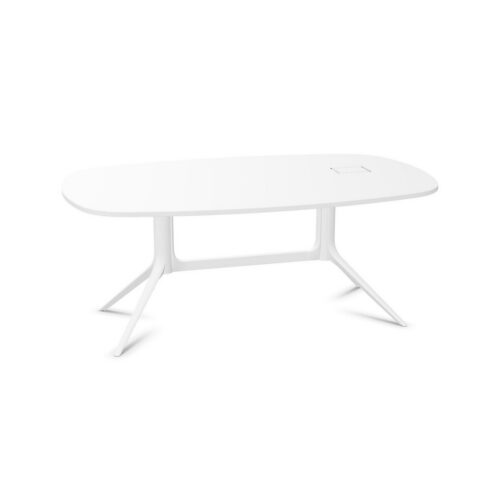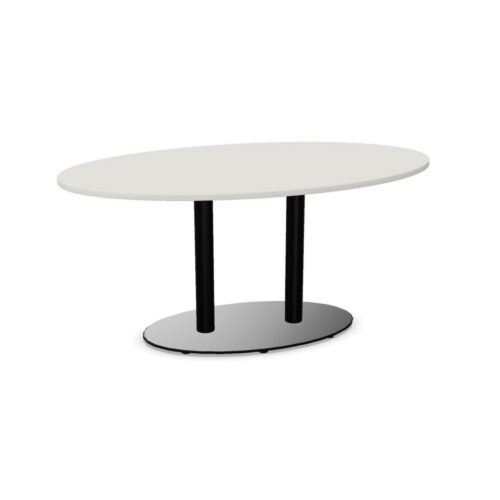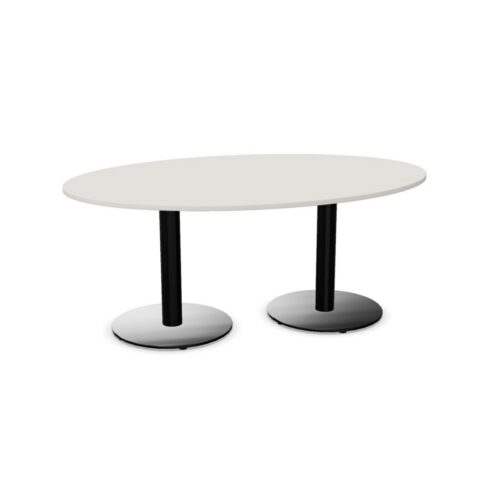


Elliptical table tops have a long, rounded plan shape, combining a generous central surface with smoothly curved ends. On Myntwork, this attribute describes the shape of the tabletop itself, rather than its finish, material, base style or the type of room in which the table is used.
An elliptical format can be a practical choice where people need to meet, share documents or work around one surface without the hard corners of a rectangular table. It is commonly considered for meeting settings, collaborative spaces and larger desk arrangements, subject to the dimensions, seating layout and base design of each individual product.
What is an elliptical tabletop?
An elliptical tabletop follows the outline of an ellipse: it is widest through the middle and curves continuously towards both ends. Unlike a rectangular top, it has no square corners; unlike a round top, it is designed to extend along a longer axis.
The shape gives a table a clear length for organising a room while retaining a softer perimeter. This can make circulation around the ends feel more natural in spaces where people move between seating, storage and presentation areas. Exact proportions vary between products, so two elliptical tables may have very different lengths, widths and usable places.
Why choose an elliptical table shape?
The main advantage of an elliptical top is the balance between shared workspace and a rounded edge. It can support face-to-face discussion while allowing participants along either side of the table to see one another more easily than they might around a long, squared layout.
- Rounded ends remove protruding corners from the table footprint.
- A long central area can accommodate meeting materials, screens or shared equipment where appropriate.
- The shape can create a less formal visual impression than a sharply rectangular boardroom table.
- Its length can help define a meeting zone within an open-plan workplace.
- Curved table ends may make it easier to route circulation around the perimeter, depending on room dimensions.
These considerations are about shape rather than a guarantee of performance. Seating capacity, cable access, stability and suitability for particular technology depend on the specification of the chosen table.
Where elliptical tables are commonly used
Elliptical tabletops are often used in meeting rooms where a conventional boardroom table is required but a softer outline suits the interior or circulation plan. They can also be useful in project rooms, training areas and multipurpose spaces that need a central shared surface.
In executive offices, an elliptical meeting table may sit alongside an individual workstation to create a separate place for visitors. In larger collaborative areas, the extended form can provide a focal point for group reviews, team discussions and informal presentations. The right application will depend on the available clearances, the number of regular users and how the room needs to change during the working day.
Elliptical shapes across office furniture
Although this archive may include different furniture configurations, the elliptical attribute applies specifically to the plan view of the top. A product may be described as a meeting table, conference table or desk according to its intended use and construction, while still sharing this tabletop outline.
For formal meeting spaces, review the available conference tables alongside the room layout and expected attendee numbers. Where the requirement is for individual or team workstations rather than a dedicated meeting surface, the wider collection of office desks can help identify appropriate formats.
Planning the room around a curved top
Measure more than the tabletop length and width. An elliptical top has a smaller corner footprint than a rectangle of comparable overall dimensions, but chairs, access routes and door swings still require space around it. Marking out the proposed footprint on a plan or floor can help a facilities team assess whether the table suits the room.
- Allow sufficient clearance for chairs to be pulled out and for people to pass behind them.
- Consider where the widest part of the top will sit in relation to walls, screens and storage.
- Check whether the table’s length aligns with the room without obstructing entrances or presentation areas.
- Plan power, data and display equipment around the selected product’s available features.
- Confirm that the base arrangement leaves adequate leg room at the seats you intend to use.
A curved edge does not eliminate the need for careful capacity planning. The usable number of places is influenced by table size, chair width, meeting duration and whether laptops, paperwork or catering will be placed on the surface.
How to compare elliptical tables
Start with the required function. A table used for brief stand-up discussions may need a different size and height from one intended for lengthy seated meetings. Then compare the overall dimensions, top finish, support structure and any integrated or compatible power provision shown on each listing.
Base placement deserves particular attention. Pedestal, leg and beam arrangements can all affect where chairs can be positioned beneath an elliptical top. If regular users need to sit at the rounded ends, check the product imagery and details to understand the available knee space and the relationship between the base and seating positions.
Questions to consider before specifying
- How many people need to use the table at the same time?
- Will the table be used principally for meetings, focused work, presentations or flexible activity?
- What clear walking routes must remain around the table?
- Do users need access to power or data at the surface?
- Which top finish and base appearance fit the wider workplace scheme?
- Will the table remain in one room or need to support changes to the layout?
Elliptical tops in a considered workplace scheme
Table shape is one part of a wider furniture decision. Pairing an elliptical meeting surface with suitable seating, storage and presentation furniture can help create a coherent setting without relying on every item to have the same form. It can also be useful to repeat rounded details elsewhere in a space, while retaining rectangular desks where linear benching or wall placement is more efficient.
For meeting-led environments, browse Myntwork’s conference table range. For work areas that require more traditional individual or shared workstation formats, see the available office desk ranges.