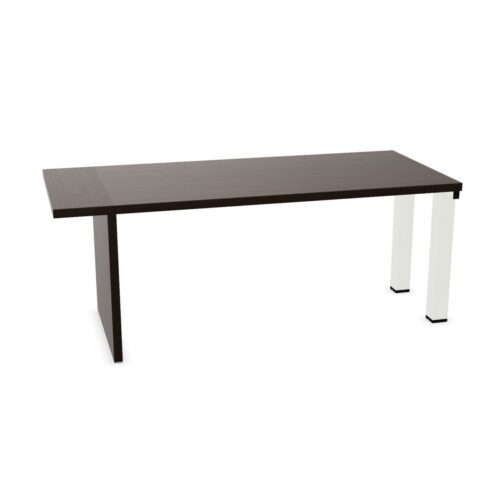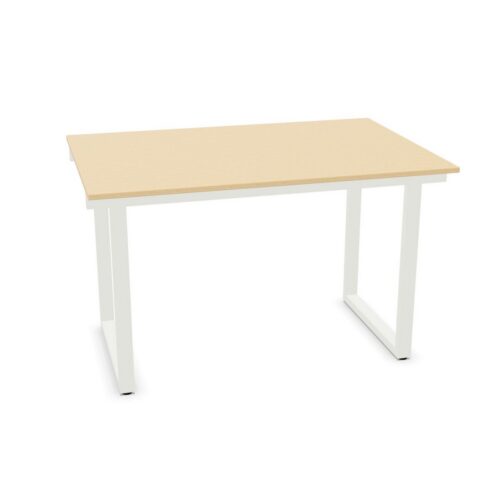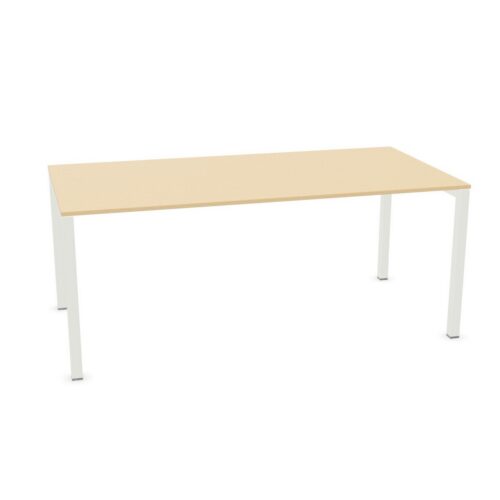


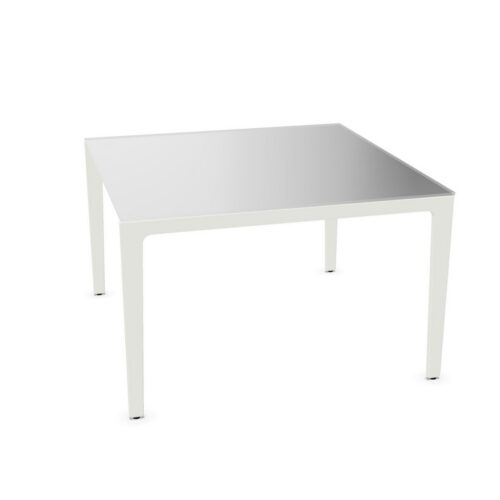
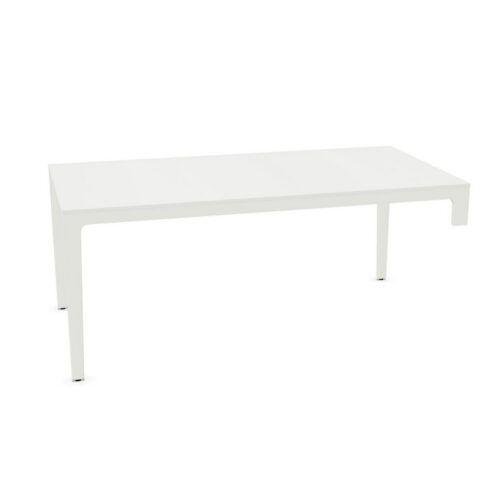
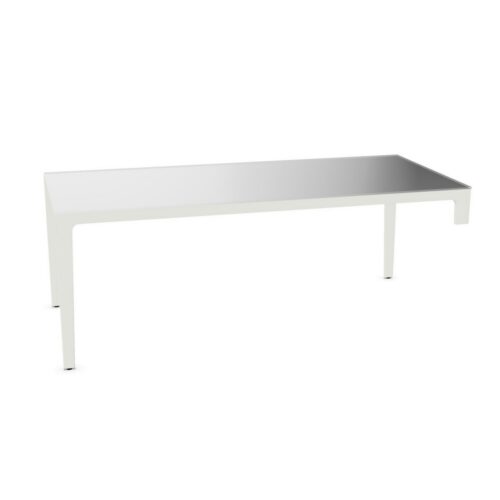
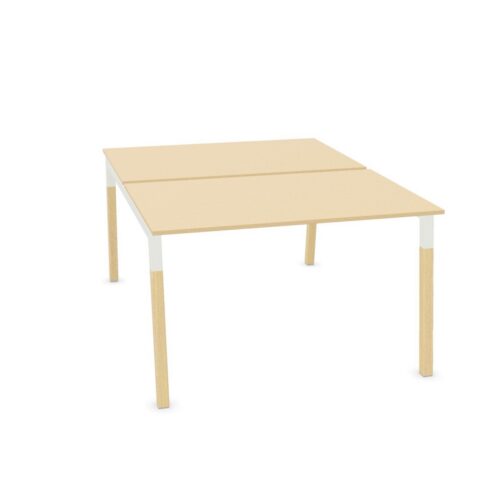
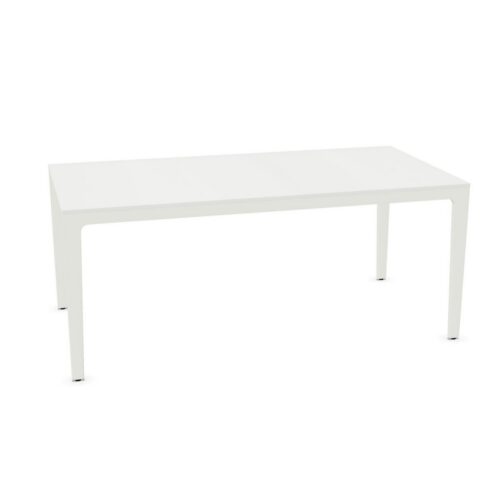
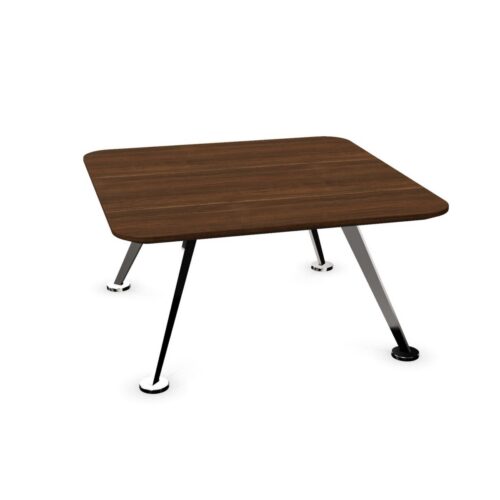
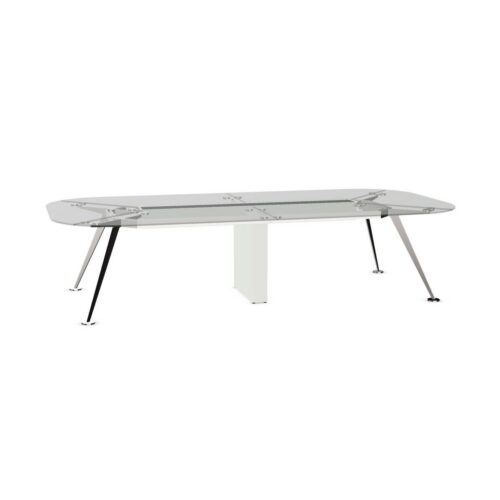
4-leg desks and tables use four individual legs positioned at the corners or close to the corners of the worktop. This familiar frame type is widely specified across offices, meeting rooms, training spaces and shared workplaces because it gives a clear, practical table layout without relying on a central pedestal or cantilevered support.
On Myntwork, the 4-leg filter identifies the geometry of the desk or table frame rather than the colour, finish or material of the frame. Designs can vary considerably: legs may be straight, angled, round, square or set back from the worktop edge, while the top, dimensions and intended use differ from product to product.
What does a 4-leg frame type mean?
A 4-leg frame has four points of support, usually one at each corner of the table or desk. A connecting rail, apron or underframe may link the legs beneath the top, depending on the design. This arrangement is distinct from a pedestal base, sled base, cantilever frame or height-adjustable desk mechanism.
For procurement teams, frame type is a useful way to narrow a broad furniture search. It helps identify products with a conventional freestanding appearance and assess whether the under-desk space, seating positions and visual style suit a particular setting.
Why choose four-legged office furniture?
Four-legged designs are used in many workplace schemes because they can suit both individual and shared use. The frame often creates a balanced silhouette that works comfortably alongside storage, task seating and other freestanding furniture. It can also make it straightforward to arrange desks and tables as single units, rows or larger groupings where the individual product design allows.
- A recognisable, traditional table and desk format for varied workplace interiors.
- Support positioned around the outer area of the worktop rather than concentrated in one central base.
- Options suitable for individual workstations, collaborative tables and meeting settings.
- A frame style available in a broad range of top shapes, sizes and finishes.
The presence of four legs does not by itself determine load capacity, stability on uneven floors, cable management provision or suitability for intensive use. Those factors should be checked against the specification of each item.
Where are 4-leg desks and tables commonly used?
This frame geometry is particularly common where a workplace needs furniture that is easy to understand, position and combine with existing layouts. A compact 4-leg desk may suit a focused workstation or touchdown area, while a larger table can provide a surface for team discussions, presentations or project work.
In meeting rooms, four-legged tables can create a familiar setting for seated conversations and laptop-based work. In training rooms and multipurpose spaces, individual tables may be arranged in classroom, boardroom or grouped formats according to the dimensions and mobility of the selected products. Reception-adjacent collaboration areas, libraries and staff rooms may also use this style where a straightforward freestanding table is required.
Desk, meeting and shared-work formats
The 4-leg filter can return furniture intended for different applications, so it is important to consider the product category as well as the frame. For individual work areas, browse Myntwork’s office desks alongside the dimensions, cable requirements and seating arrangement needed for each workstation.
For larger groups, the same frame principle may appear on rectangular, round, square or more specialised table shapes. Four legs can provide a useful visual rhythm around a room, but the location of legs relative to chairs matters more on larger tops. Review the seating plan and ensure that leg positions do not interfere with the places people are expected to use.
Choosing a 4-leg frame for your layout
Start with the intended activity and the available floor area. Measure not only the tabletop footprint, but also the space required for chairs, circulation, access to storage and clearance around doors or shared routes. A leg positioned directly at a corner may be unobtrusive for one user, yet affect comfort when several people sit around the same table.
Consider how the frame will relate to other furniture. Set-back legs can leave more room at the corners, while legs closer to the outer edge may make the support structure more apparent. Neither arrangement is universally preferable; the appropriate choice depends on the product’s size, the seating pattern and the way the room will be used.
- Match worktop width and depth to monitors, laptops, papers and other equipment.
- Check whether the proposed chair positions align comfortably with the legs and rails.
- Allow for wheelchair access and clear circulation where required by the project.
- Review frame finish and top finish separately from the 4-leg filter value.
- Confirm whether cable ports, modesty panels, levelling feet or linking features are included on the specific product.
Questions to consider before specifying
Will the furniture be used by one person or several?
A desk used by one person can be planned around a single chair position and equipment setup. A shared table needs a more detailed check of how many places can be used comfortably, including whether the frame intrudes into knee space at the ends or sides.
Does the room need to be reconfigured?
If tables will be moved regularly, assess the product’s overall weight, dimensions and any features intended to support repositioning. A 4-leg frame describes the supporting form only; it does not indicate that a product is folding, stacking, wheeled or designed for frequent movement.
How will the furniture sit on the floor?
Floor finish and level can affect day-to-day performance. Check the individual product details for any adjustable feet or other relevant provisions, particularly where tables will be installed across large areas or on surfaces with slight variation.
Frame type, finish and visual coordination
Frame type should be considered alongside the wider furniture palette. A four-legged structure can be visually light or substantial depending on leg profile, material and finish, as well as the thickness and shape of the top. It may be selected to complement task chairs, storage, screens or existing meeting furniture, but the 4-leg classification alone does not define those characteristics.
For a coordinated scheme, compare product imagery and specifications rather than assuming that items with the same frame type will match. This is especially relevant when furnishing several rooms or combining individual desks with larger shared surfaces.
Related Myntwork ranges
Explore Myntwork’s conference tables for larger meeting and collaboration settings, or return to office desks when planning individual workstations and bench-style workplace layouts. Filtering by frame type can be a useful starting point, followed by the dimensions, top shape and product features needed for the finished space.
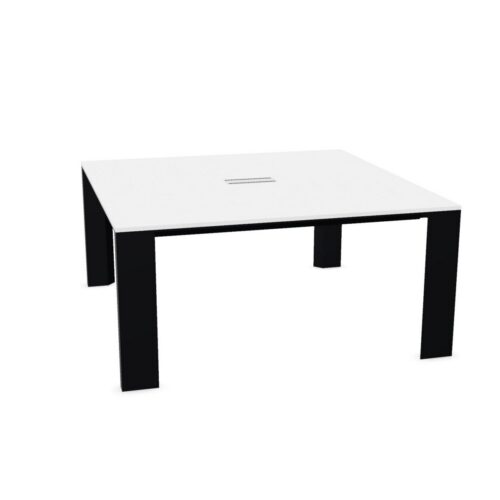







Frezza

Frezza