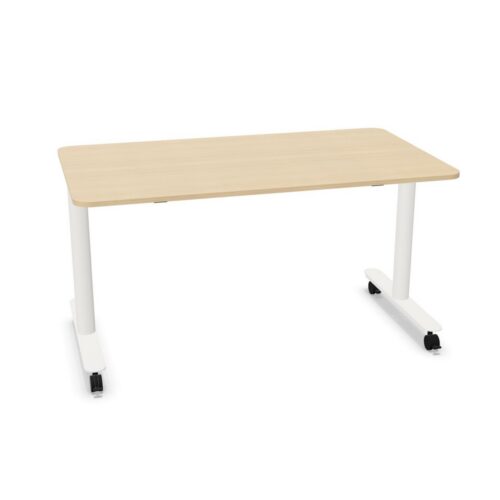


T-leg desk and table frames use a support positioned across the width of the worktop, creating a recognisable T-shaped profile when viewed from the end. This frame geometry is widely used in workplace furniture because it provides a clear, practical base for individual desks, benching layouts, meeting tables and other shared work surfaces.
On this page, the T-leg filter refers specifically to the form of the supporting frame, rather than the colour, material or finish of the furniture. Products may differ in size, top shape, adjustment options and intended setting, but each has a T-leg frame arrangement as part of its design.
What is a T-leg frame?
A T-leg frame generally consists of a vertical upright meeting a horizontal foot or support at floor level, with the worktop fixed above. The cross-section resembles the letter T. Depending on the product, the upright may sit centrally below the end of a rectangular top or form part of a linked frame running beneath a larger table.
This construction separates the support structure from the edges of the top in a straightforward way. It can give desks and tables an uncluttered appearance while leaving useful room for a chair, legs and everyday movement beneath the work surface.
T-leg should not be confused with other frame descriptions. A four-leg table has separate legs at the corners, while cantilever, sled and pedestal bases use different supporting geometries. The right choice depends on the workspace, the top being specified and how people need to sit, move and work around it.
Why T-leg desks are common in workplaces
T-leg frames suit many office planning requirements because they offer a familiar, adaptable layout. They can work well as a standalone desk, in aligned rows or as part of a wider workstation scheme. The open area under the top is particularly relevant where users need to pull chairs in close or change position during the day.
- A simple frame format that can suit focused workstations and shared office layouts.
- Clear access beneath the desk for seating and routine cleaning.
- A balanced visual profile for contemporary and more traditional workplace interiors.
- Potential to coordinate desks and tables with related frame finishes across a project.
- A practical starting point when comparing different worktop sizes and configurations.
The presence of a T-leg frame alone does not determine the overall capability of a desk or table. Details such as top depth, leg placement, cable management, levelling feet, modesty panels and height adjustment vary by model and should be checked on the individual product specification.
Suitable uses for T-leg furniture
T-leg bases are used across a range of commercial settings. In open-plan offices, they can provide consistent individual workstations in banks or rows. In private offices, the same geometry can support a simple desk arrangement without making the room feel over-furnished.
They are also relevant to project spaces, training rooms and meeting environments. A larger top on a T-leg structure may accommodate collaborative work, presentations or informal discussions, while a more compact table can provide a useful touchdown or support surface.
- Individual desks in open-plan and cellular offices.
- Hot-desking and touchdown areas where layouts may need to remain easy to understand.
- Training rooms, classrooms and multi-purpose workspaces.
- Meeting and collaboration rooms with tables sized for the available footprint.
- Home-office or satellite-office settings requiring a business-appropriate work surface.
T-leg frames across desk and table types
The T-leg attribute can appear on more than one type of workplace furniture. For desk procurement, it is useful to compare the overall footprint as well as the frame geometry. A compact rectangular desk may suit a single user, whereas a larger workstation or linked run may be better for teams that need matching positions.
For tables, consider how the legs affect seating around the perimeter. The location of uprights and feet may influence where chairs can be placed, especially on shorter sides or at the ends of a table. This is worth reviewing alongside the chosen chair dimensions and the circulation space around the furniture.
Browse the wider selection of office desks when planning individual work areas, or compare conference tables for formal meeting rooms and larger collaborative settings.
Planning a T-leg desk layout
Before selecting a frame style, measure the room and account for the complete working area rather than the worktop alone. The space needed for chairs to move, people to pass behind seated users and doors or storage to operate can be as important as the desk dimensions.
Where several desks are being specified, consistency can simplify a layout, but it should not override practical requirements. Consider whether users need privacy screens, monitor arms, desk-mounted accessories or power provision. These requirements may affect the preferred top size and the way desks are positioned in relation to one another.
Questions to consider
- What worktop width and depth does each user require?
- Will the frame leave suitable clearance for the selected task chair?
- How much aisle space is needed around occupied desks or tables?
- Are cable routes and power access required at the workstation?
- Will desks be used independently, arranged in rows or linked into a larger configuration?
- Does the table need to accommodate seating on all sides?
Choosing frame finish and worktop combination
Frame type describes the structure, not its appearance. T-leg products may be offered with different base colours and with tops in a range of finishes. When specifying several items, compare the stated frame finish separately from the worktop colour, edge detail and any upholstery or screen materials included with the product.
A coordinated scheme may help establish a consistent look across workstations and meeting spaces, while mixed finishes can distinguish zones within a larger office. In either case, use product imagery and specification details to confirm the exact combination available for the item under consideration.
Comparing T-leg frames with other options
A T-leg frame is often a sensible choice where an open under-desk area and a straightforward office aesthetic are priorities. However, other base styles may better suit particular tops, room layouts or operational needs. Pedestal bases can be useful where uninterrupted seating around a table is important, while four-leg designs may be preferred for a more conventional table profile.
Compare the frame in context: the dimensions of the top, the seating plan, the floor surface and the intended use all matter. Reviewing these factors early helps ensure that the selected furniture supports the practical demands of the space as well as its visual plan.
Related Myntwork workplace furniture
T-leg products can form part of a wider workplace specification, from focused individual workstations to shared meeting areas. For desks, consider top dimensions, storage requirements and the needs of the people using the space each day. For tables, assess participant numbers, room proportions and the equipment likely to be used during meetings.
Explore Myntwork’s office desk range for everyday work areas, and view conference tables when planning meeting, boardroom and collaboration spaces.