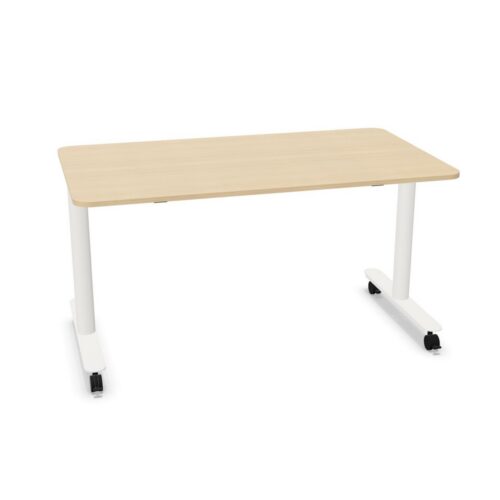


Corner table tops are shaped in plan to make effective use of a room corner, often creating an L-shaped or returned work surface. They provide a practical way to add usable desktop area without placing a large rectangular table in the middle of the room.
For workplace planning, the tabletop shape is an important distinction. A corner top affects how a desk, workstation or meeting table sits against walls, how people move around it, and where screens, documents and equipment can be positioned. The products shown here are grouped by the shape of the top itself, rather than by colour, base style or a particular workplace use.
What does a corner table top shape mean?
A corner-shaped top is designed around a change of direction, allowing the surface to follow two adjoining walls or form an extended workstation layout. Many are recognised as L-shaped tops, with one main working area and a secondary return. Some may have curved, angled or softly radiused inner and outer corners, while others use straight edges.
The precise footprint varies between products. A corner configuration can be left- or right-handed, can include unequal-length sides, and may be supported by different leg, frame or storage arrangements. Check the individual product dimensions and orientation before selecting furniture for a particular room position.
Why choose a corner-shaped work surface?
Corner tops can organise a workstation around the natural geometry of an office. Rather than treating a corner as unused space, the layout can turn it into a focused work area with room for day-to-day tasks on more than one side.
- They can provide a larger continuous working surface than a compact straight desk.
- They help position workstations along the perimeter of cellular offices and open-plan areas.
- They can separate activities, such as screen work on one side and paperwork or reference material on the other.
- They may leave the centre of a room clearer for circulation, visitors or shared equipment.
- They suit layouts where a user needs nearby access to power, storage or a return surface.
These benefits depend on the overall product design and the available space. The tabletop shape alone does not indicate cable management, integrated storage, adjustable height or any particular base construction.
Typical settings for corner tables
Corner-shaped tables are commonly considered for individual offices, home-working rooms, reception back offices and focused work zones. They can also be useful in project spaces where one person needs a generous work area without occupying a central bench.
In a private office, a corner desk can support a screen-facing position with a separate side for discussions, files or a laptop. In an open office, several corner workstations may be planned around walls or architectural features, provided there is sufficient clearance behind chairs and along access routes. For shared settings, a corner top may also form part of a larger configuration rather than operating as a standalone desk.
Products available with corner tops
This filter can include different types of workplace furniture whose defining feature is the corner plan shape. The range may cover workstation-style desks, executive desks, table systems and modular components. A corner top should therefore be assessed alongside the product category, not selected on shape alone.
- Individual workstations: suitable where one user needs a primary desk area and a side return.
- Modular desk arrangements: useful when building a layout around walls, pillars or room corners.
- Managerial or private-office desks: often chosen for a more expansive personal working area.
- Collaborative table configurations: applicable where corner-shaped elements help create a wider meeting or project layout.
If the requirement is primarily for group discussion, compare the available shapes and sizes within our conference tables range. A dedicated meeting table may offer a more appropriate seating arrangement than a corner workstation.
Planning a corner workstation
Start with the usable dimensions of the room, including skirting, radiators, glazing, door swings and the position of sockets. Measure both walls that will define the corner, then allow for the desk depth, chair movement and a clear route into the space. A top that fits on paper may feel restrictive if the return projects into a doorway or walkway.
Orientation is equally important. A left-hand and right-hand corner desk are not interchangeable when the return needs to sit against a specific wall. Consider the user’s preferred screen position, the side on which visitors will sit, and whether drawers or pedestal storage need to remain accessible.
Questions to consider before selecting
- Which corner of the room will the table occupy, and is the required return left- or right-handed?
- What width and depth are needed for monitors, a laptop dock, documents and other regular equipment?
- Will the desk be used by one person, or should the layout accommodate short meetings?
- Where are power and data points located, and how will cables reach the work surface?
- Is there enough space for the user’s chair and for colleagues to pass safely?
- Does the chosen base, leg position or storage option affect legroom at the inside corner?
Matching shape with workplace function
A corner top is most effective when it reflects the way the space will be used. For concentrated individual work, the main section can accommodate screen-based tasks while the return supports writing, calls or reference materials. Where collaboration is more frequent, consider whether the corner arrangement permits visitors to sit comfortably without interrupting circulation.
It is also worth considering future changes. Modular furniture may make it easier to reconfigure a team area, but compatibility between tops, frames and accessories should be confirmed at product level. Finishes and base options can be selected separately from the top shape where those choices are offered.
Related office furniture ranges
For individual and team workstation planning, browse our wider selection of office desks, including straight, bench and other desk formats. For spaces intended around formal discussions, presentations or larger shared work surfaces, the conference table category provides a useful comparison of meeting-focused options.
When reviewing corner table tops, use the product specifications to confirm dimensions, handedness, supporting structure and suitability for the intended room layout. This helps ensure that the chosen shape supports both the available floor space and the practical needs of the people using it.