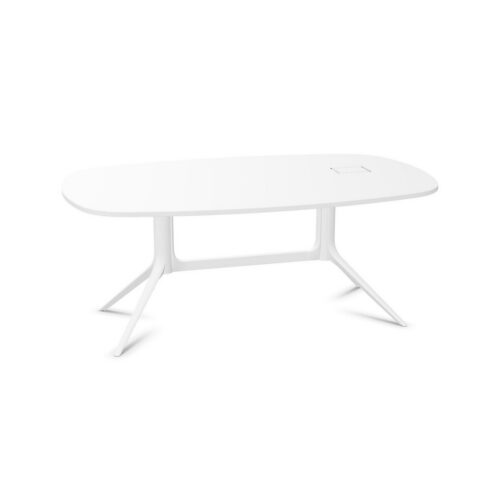


Square table tops give workplace tables an even, balanced footprint, with four sides of the same length and right-angled corners. In an office furniture plan, this tabletop shape can support individual work, small meetings, café-style seating and flexible shared areas while making efficient use of regular room layouts.
This filter refers specifically to the plan shape of the tabletop, rather than the shape of a table base, the edge profile or the finish. Square tops are available across different table types, sizes, materials and base arrangements, so the surrounding specification still matters when selecting furniture for a project.
What does a square tabletop shape mean?
A square tabletop has equal-length sides, creating a compact surface with a central focal point. Unlike rectangular tops, it does not prioritise a long direction; unlike round tops, it retains straight edges that can sit neatly alongside walls, partitions or other tables.
The shape is especially useful where a consistent grid is needed. Several square tables can be positioned in rows, placed side by side for larger groups, or separated to create individual stations. The same basic geometry can work in a formal meeting setting or a more informal breakout area depending on the table height, finish, seating and base design.
Why choose square tables for a workplace?
Square tables can make planning straightforward in rooms with rectilinear architecture. Their equal-sided format gives each person around the table a similar relationship to the shared surface, which can suit small discussions, collaborative tasks and casual conversations.
- They provide a clear, symmetrical layout for compact meeting and dining settings.
- Straight sides can align with walls, banquette seating and other furniture.
- Matching tables can be combined to form larger square or rectangular arrangements when layouts change.
- The format can suit both dedicated work areas and multipurpose spaces.
- A square footprint can help maintain consistent circulation routes in regularly planned rooms.
For procurement teams, a repeated square table specification can also help create visual consistency across floors or sites. It is still important to check the dimensions of each product rather than assuming all square tables offer the same number of places or the same usable working area.
Where are square table tops commonly used?
Square top tables are often selected for small meeting rooms, touchdown zones, staff cafés and reception-adjacent waiting areas. In these spaces, the balanced shape can encourage face-to-face interaction without requiring a large central table.
They can also be practical in training rooms and project spaces where furniture needs to be rearranged. A group of individual square tables may be configured for separate tasks, paired for a larger working surface, or arranged in clusters. The suitability of this approach depends on the table construction, mobility options and the available floor space.
- Breakout and café areas: compact tables for informal breaks, conversations and laptop use.
- Small meeting rooms: shared surfaces for short discussions and one-to-one meetings.
- Open-plan offices: occasional collaboration points away from assigned desks.
- Training and learning areas: layouts that can be adapted for individual or group activities.
- Reception and hospitality spaces: tables that sit comfortably within neat, modular furniture plans.
Square tables, desks and meeting furniture
The same tabletop shape appears in different furniture categories, but its purpose changes with the product. A low square occasional table may support an informal lounge setting, while a standard-height square table may be intended for dining or quick meetings. A larger square meeting table can provide a shared work surface for a small group.
In work settings, consider whether users need space for monitors, papers, power access or personal equipment. A square top may be appropriate for a focused individual workstation or a compact shared table, but a longer work surface can be more suitable where each user needs a clearly defined position. Browse relevant office desks where personal task work is the main requirement, and consider conference tables for more formal collaborative settings.
How to choose the right square tabletop
Start with the dimensions of the room and the intended number of users. The width and depth of a square top are equal, so its overall size should be considered alongside chair space, access routes and adjacent furniture. Measure the table zone rather than the room alone, allowing sufficient clearance for people to pull out chairs and move around occupied positions.
Next, review height and use. Standard-height tables may serve meetings, dining or desk-based tasks, whereas poseur-height options are generally used with higher seating or for standing interactions. Base placement is equally important: a central pedestal may offer more legroom around the edge, while four legs can affect where chairs are positioned. This is separate from the tabletop shape and should be checked in the individual product details.
Questions to consider
- How many people need to use the table at the same time?
- Will it be used mainly for laptops, meals, papers, informal conversations or mixed activities?
- What clearance is required for chairs, walkways and accessibility?
- Should several tables join together or be stored and moved independently?
- Which table height works with the seating already specified?
- Does the selected base leave sufficient room for users’ legs and chairs?
Finishes, edges and bases
A square shape establishes the footprint, but finish and construction determine how the table contributes to the wider interior scheme. Top colour, surface material, edge treatment and frame finish can be coordinated with seating, storage and surrounding joinery. These choices should be assessed separately from this shape filter.
For busy shared areas, it can be useful to consider how the surface will be used and maintained, as well as how it will look alongside other furniture. In project specifications, retain product-level details for dimensions, top thickness, base style and any optional accessories. This helps ensure that visually similar square tables are compared on their practical suitability, not shape alone.
Planning square tables in a flexible layout
One advantage of a square format is its modular character. Equal-sided tables can be arranged in pairs, larger blocks or separated into smaller groups without introducing different tabletop proportions. This may be useful in spaces that alternate between meetings, training, eating and informal project work.
Before finalising a layout, test the intended configurations against the room plan. Consider doors, circulation, power points, storage access and sightlines, particularly when tables are likely to move. A consistent tabletop shape can bring order to a flexible space, provided the selected products support the operational needs of the workplace.
Related Myntwork furniture ranges
Square tabletop furniture can form part of a wider workplace setting, from focused workstations to collaborative rooms and shared social spaces. Explore Myntwork’s conference tables for meeting-focused layouts, or review office desks when individual work and everyday task space are the priority.