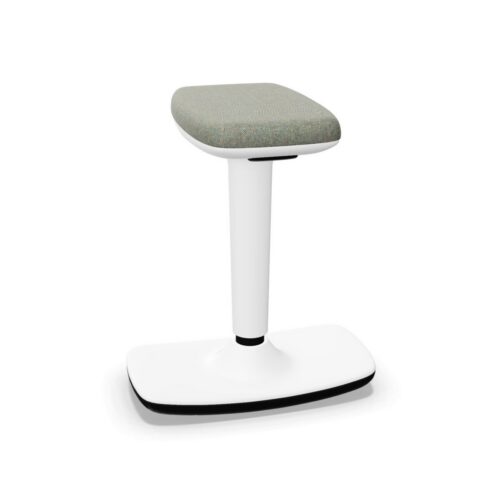


Sit-stand stools provide a flexible seating option for workstations where people alternate between sitting, standing and short, active tasks. Positioned between a conventional office chair and fully standing, they can support a more varied posture during the working day.
This type of office chair is commonly considered alongside height-adjustable desks, benching and counter-height work surfaces. Designs vary in seat shape, height range, base style and degree of movement, so the right choice depends on the workstation, the task and the people using it.
What is a sit-stand stool?
A sit-stand stool is a raised, compact seat intended for perching or supported sitting at an elevated work surface. It allows the user to take some weight through the seat while maintaining a more open hip position than they may have in a standard desk chair.
Unlike a task chair, a sit-stand stool may have a smaller seat and may not include a backrest or armrests. It is therefore generally selected for intermittent use, active work or work patterns that involve regularly changing position, rather than automatically replacing every chair at every desk.
Why use a sit-stand stool in the workplace?
Changing working position can be useful where a person spends time at an adjustable desk or moves between screen work, collaborative activity and brief desk-based tasks. A stool gives users an alternative to continuous standing without requiring them to lower the whole workstation.
- It can support sit-stand routines at compatible height-adjustable desks.
- Its compact footprint can suit work areas where a full-size chair would take up more room.
- It can provide a convenient perch for short meetings, touch-down work and shared workstations.
- It may help teams create a mix of seated, perching and standing settings within one office.
The benefit is not simply the stool itself, but how it is matched to the way a space is used. Staff should still be able to set up their screen, keyboard, work surface and seating position appropriately for the task.
Typical settings for sit-stand stools
Sit-stand stools are often used at adjustable desks, standing-height project tables and other elevated work points. They can be practical in agile offices where employees do not remain at one allocated desk all day, provided there is a suitable choice of work settings available.
They are also relevant for roles involving frequent short interactions with a desk or counter, such as reception-adjacent work, design review areas and shared technical spaces. In these settings, the stool can make it easier to pause and perch while retaining the option to stand and move around.
For longer periods of concentrated screen work, assess whether users will also need access to a conventional adjustable chair. A sit-stand stool is one part of a considered workstation arrangement, rather than a universal answer for every employee or task.
Styles and features to compare
Products grouped as sit-stand stools can look quite different. Some have a round or saddle-style seat; others use a broader, more structured perch. Bases may be designed for a fixed location or for easier movement around a workspace. These differences affect how the stool feels, how it fits beneath a worktop and how readily it can be shared.
- Height adjustment: check that the available adjustment suits the desk, counter or table height in use.
- Seat form: consider the shape, padding and edge profile in relation to expected duration and movement.
- Base configuration: select a base that is appropriate for the floor finish, required mobility and surrounding circulation.
- Foot support: an appropriate footrest or support can be important at raised seating heights.
- Finish and cleanability: consider the office environment, maintenance requirements and the wider furniture scheme.
Choosing a stool for a height-adjustable desk
Start with the working height rather than the appearance of the stool. Measure the desk across the range at which it will normally be used, then compare this with the stool’s usable seat-height range. The aim is to give users a supported position without forcing shoulders to lift, wrists to bend awkwardly or feet to hang without support.
Consider who will use the workstation. A stool chosen for a named user may be set up differently from one in a shared environment. In a hot-desking area, straightforward adjustments and a clear workstation set-up process may be more important than a highly specific configuration.
Also review the surrounding space. A compact stool can assist with clearance at busy desks, but aisles, storage access and movement around colleagues should remain unobstructed. Where the stool will be used on a particular floor surface, assess the base and any castors in line with the intended setting.
Questions to consider before specifying
Workstation and task requirements
- Will the stool be used with an adjustable desk, a fixed-height counter or a meeting table?
- How long are users likely to perch at one time?
- Is it an additional option beside standard seating, or the primary seat at that position?
- Does the work involve a monitor, laptop, paperwork, conversations or frequent movement away from the desk?
- Are there user needs that call for a backrest, arm support or a different seating solution?
Involving facilities, workplace teams and end users early can help ensure that the furniture layout supports both everyday activity and individual adjustments. It is also sensible to consider the full desk set-up, including monitor position and foot support, rather than procuring stools in isolation.
Sit-stand stools within a wider seating plan
A balanced office seating plan usually offers more than one posture and work setting. Sit-stand stools can complement task seating, meeting chairs and informal touchdown furniture, giving people a suitable option when they need a higher, more active perch.
For a broader view of available seating, see the Myntwork range of office chairs. Guidance on evaluating seat type, adjustment and workstation fit is also available in our resource on how to choose an office chair. These category and guidance pages can help place sit-stand stools within a practical, well-considered workplace furniture specification.