


Purple office upholstery appears on lounge armchairs, meeting chairs, task seats and sofas. The covering may be fabric on a seat, back or fully upholstered shell. Its visual effect depends on that coverage and the number of seats in the room. A single lounge chair can act as an accent; a row of upholstered meeting chairs creates a broader field of color. Begin with the seat’s role, then assess the fabric. Consider how the purple fabric will be seen when chairs are occupied. Bags, coats and people may hide the seat but leave the backrest visible. A sofa along a corridor will be viewed from behind, while a chair at a table may present its front to visitors. These views help decide where the color belongs and which side of the upholstery needs the closest finish comparison. The furniture should still be easy to approach and clean.
Shape a lounge group
A fully upholstered armchair with integrated arms gives a distinct individual position within a conversation area. Place it where someone can approach easily and see the other people in the group. Purple office upholstery on a complete armchair is visible from many angles, so compare the front, sides and back in the intended room.
A lounge chair can be paired with a sofa or low table, but leave enough room to stand and move between pieces. If several purple upholstered elements are planned, test their combined effect at full scale. A small swatch can understate the impact of a large fabric surface.
Give conference seating a table
A low upholstered conference chair is meant to work with a meeting table. Check its seat height, arm position and how the frame moves on the floor. Purple office upholstery may cover the backrest while the base remains metal. View the chair from the room entrance, where its back may be more visible than the seat.
Meeting rooms used by many groups need a practical fabric choice. Review the selected textile’s care information and how easily chairs can be cleaned or moved. Draw occupied positions to check circulation. Upholstery can connect the chairs visually, but spacing keeps the room usable.
Check task-chair function separately
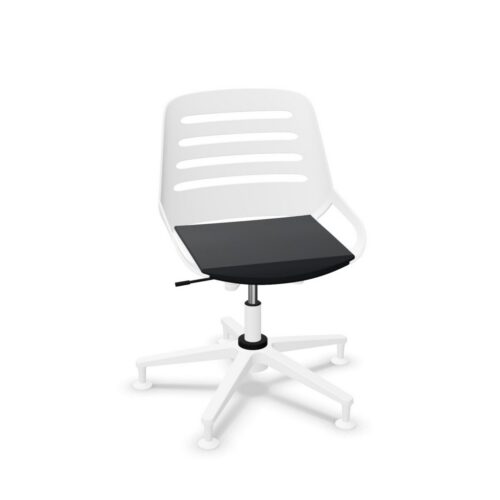
At a workstation, chair adjustment and posture take priority. Purple office upholstery can make a task seat stand out against a neutral desk, but it should not influence whether the chair fits the user. Check the selected model’s controls, arm clearance and movement around storage. Identify which surfaces are actually upholstered.
Some seating families include unupholstered plastic or plywood variants. Do not assume every seat in a family carries purple fabric. Confirm the chosen configuration before planning a color match. This is particularly important when a task chair and lounge chair use different covering types.
Bring sofas into the plan
An upholstered sofa can define the edge of a social area or create a soft center. Arrange it for conversation and add a reachable low surface where needed. Purple office upholstery across a broad sofa may dominate the view from a corridor, so assess its placement from outside the group as well as from within.
Modular sofas may change configuration. Check how upholstered backs and arms appear when pieces are rearranged. A fabric that looks balanced in one layout can form a much larger block of color in another. Plan the intended arrangements and storage for unused modules.
Compare textile in real light
Purple can read warm or cool depending on weave and lighting. Bring swatches into the intended rooms. Compare them with flooring, walls and table finishes. A textured fabric can show several tones at close range. If chairs sit directly beside one another, compare actual materials rather than relying on a shared color name.
Purple office upholstery should be maintained according to its specific textile. A lounge armchair, task seat and meeting chair may have different care needs. Select each for the activity and expected handling. Color continuity is useful only when the seating remains comfortable and practical.




Arte & D


