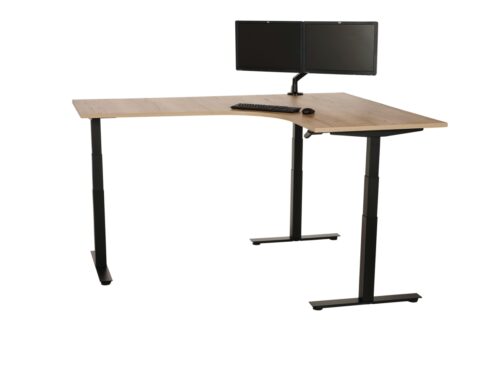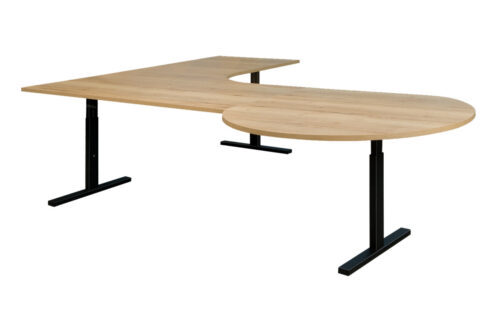


Corner desks make purposeful use of two adjoining walls or a room corner, creating a generous work surface without placing a freestanding desk in the middle of the floor. For workplace planners, facilities teams and growing businesses, this configuration can help organise individual workstations while keeping circulation routes clear.
A corner desk is defined by its workplace layout rather than a particular material, finish or operating mechanism. The products shown here may vary in size, return position, storage options, leg design and whether they are fixed-height or height-adjustable, so it is useful to assess each specification against the intended user and room.
What is a corner desk?
A corner desk, often described as an L-shaped desk or desk with a return, brings two work surfaces together at an angle. The primary desk section can accommodate a screen, keyboard and day-to-day paperwork, while the return offers space for a second monitor, telephone, reference materials or a small meeting position.
Some designs are made as one continuous worktop, while others use linked components. Returns may be left- or right-handed, and certain desk systems can be configured either way during planning. This distinction matters: a desk that fits neatly in one corner may obstruct access, windows or storage when reversed into another.
Why choose a corner desk for the workplace?
The main benefit is worktop area in relation to the desk footprint. By following the perimeter of a room, a corner desk can provide a broad, practical workstation while leaving a more open central area. It can also create a clear division between screen work and administrative tasks.
- Provides room to separate IT equipment, documents and personal working space.
- Uses corners that may otherwise be underutilised in cellular offices and home-working rooms.
- Can support focused individual work without needing a large central bench arrangement.
- Helps define a workstation in shared offices, studios and departmental spaces.
- May allow drawers, pedestals or low storage to sit close to the user, subject to the chosen layout.
Space efficiency should not be assumed from the shape alone. A deep return or oversized worktop can take up considerable room, particularly where a task chair needs clearance to move freely. Accurate planning remains important.
Where are corner desks commonly used?
Corner configurations are particularly familiar in private offices, management rooms and roles that combine computer-based work with paperwork or equipment. They can also work well in reception back offices, finance departments, design studios and project spaces where users need more than one active work zone.
In smaller offices, positioning desks against walls can preserve an open route through the room. In a home-working setting, a compact corner desk may establish a dedicated working area away from the main living space. For larger floorplates, corner desks can be used around structural columns, within enclosed rooms or as part of planned workstation clusters where the overall geometry permits.
Desk types and features to compare
Not every corner desk is the same in day-to-day use. The archive may include fixed desks, sit-stand models, executive-style workstations and modular desk systems with returns. Look beyond the L-shaped outline to understand how the product will function in context.
- Handedness: confirm whether the return sits on the left or right when the user is seated, and whether it can be changed.
- Overall dimensions: consider the width and depth of both sections, not just the longest edge.
- Worktop depth: ensure there is appropriate space for screens, input devices and a comfortable viewing distance.
- Height adjustment: where available, check how the adjustable elements work and whether the full corner arrangement moves together.
- Cable management: identify the position of cable ports, trays and power access in relation to screen and wall locations.
- Storage compatibility: check that pedestals, cupboards and drawers do not restrict legroom or chair movement.
Planning a corner workstation
Begin with the room rather than the desk. Measure both walls, note skirting, radiators, sockets, windows and door swings, then mark the chair zone and access route. A desk can fit between two walls yet still be impractical if the user cannot pull their chair back or if visitors cannot enter the room comfortably.
Consider the likely screen position early. Placing monitors directly in front of a bright window may create glare, while positioning a workstation with the user’s back to a doorway may be unsuitable for the role or setting. Cable routes should also be planned before installation, especially when power outlets are distant from the desk corner.
Questions to consider
- Which corner of the room gives the user the clearest, least obstructed working position?
- Will the return be used for a second screen, paperwork, meetings or specialist equipment?
- Is left- or right-hand orientation required for this particular location?
- Does the chair have enough room to move, and can people pass behind it safely?
- Are power, data and cable-management requirements covered by the selected configuration?
- Will the desk need to work with existing storage, task seating or monitor arms?
Comfort and workstation set-up
A larger desk does not automatically create an ergonomic workstation. Arrange frequently used items within easy reach and keep the area beneath the primary work surface clear for the user’s legs. Screens, keyboard, mouse and chair settings should be considered together, particularly where the return encourages equipment to be placed at an angle or beyond a comfortable reach zone.
For broader guidance on setting up individual work areas, see the Myntwork ergonomic workplace guide. It can help inform decisions on desk dimensions, seating and display-screen placement alongside the specific corner configuration.
Related desk ranges at Myntwork
Corner desks suit workplaces that need an organised, substantial individual workstation, but other layouts may better fit open-plan teams, touchdown areas or compact rooms. Compare dimensions, configurations and supporting furniture across our range of office desks when planning a coordinated workspace.
For projects with multiple room types, combining corner workstations with other desk formats can provide a consistent approach while allowing each area to meet its own practical requirements.