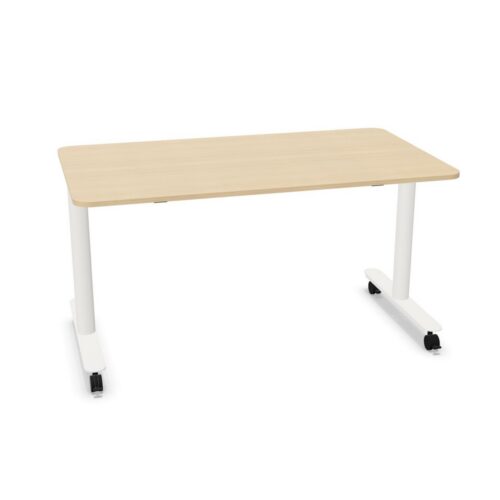


Straight-leg desks and tables use upright legs that run directly from the worktop towards the floor, creating a clean, familiar frame profile. On Myntwork, this frame type can appear across individual desks, shared worktables and meeting tables, with dimensions, materials and supporting elements varying by product.
The simplicity of straight legs makes them a practical consideration for workplace procurement. Their appearance suits a wide range of interiors, while the open space beneath the top can support everyday seating, cable access and reconfiguration planning. The frame geometry is only one part of a specification, however, so it should be reviewed alongside the individual product’s size, finish and functional details.
What does a straight-leg frame type mean?
A straight-leg frame has legs that are visually vertical or near-vertical rather than angled, splayed, looped or pedestal-based. Legs are commonly placed near the corners or ends of a desk or table, although the exact inset, crossbars, rails and fixing arrangement differ between designs.
This descriptor relates specifically to the supporting frame geometry. It does not, by itself, define the worktop material, the colour of the frame, whether a desk has cable management, or the number of people a table accommodates. Check each listing for those details before comparing items for a project.
Why straight legs are widely used in workplaces
Straight-leg frames provide an uncomplicated visual foundation for work settings. Their restrained profile can work in established offices, newly fitted spaces and mixed furniture schemes where a consistent, orderly look is required. They also allow the top to remain the most prominent element, which can be useful when selecting finishes to align with an existing workplace palette.
- A straightforward silhouette that can sit comfortably with many office furniture styles.
- Open under-desk space that may make it easier to position task chairs and personal items.
- A familiar format for individual workstations, project tables and meeting-room layouts.
- A frame style that can be considered alongside a range of top shapes and sizes.
- Clear leg positions that help planners assess seating and circulation around the furniture.
For procurement teams, the attraction is often consistency rather than a single design feature. Selecting compatible straight-leg models across different areas can help create a coherent visual language while allowing each zone to have an appropriate table or desk size.
Typical uses for straight-leg desks and tables
Individual workstations are a common application. A rectangular desk with straight legs can give a user a defined work surface while retaining a light, conventional appearance. In shared offices, similar frames can be specified across a run of desks where coordinated dimensions and finishes are available.
Straight legs are also frequently seen on tables used for collaboration. In a meeting room, they can provide a simple frame around which chairs are arranged, helping to keep the table form easy to read within the room. For more information on suitable formats, browse Myntwork’s conference tables.
Other settings may include touchdown areas, training rooms, project spaces and staff break-out zones. The suitability of a particular product will depend on its measurements, intended use and the clearance available around it, rather than on frame type alone.
Desk and table formats to compare
Filtering by straight legs can bring together several kinds of workplace furniture. Comparing the overall format first helps narrow the options to pieces that suit the function of the space.
- Single desks: for assigned work areas, focused tasks and smaller office footprints.
- Bench-style worktables: for shared settings where multiple users work at one continuous surface.
- Meeting tables: for discussions, presentations and collaborative work.
- Training or multipurpose tables: where layouts may change with the activity being hosted.
- Occasional worktables: for informal tasks, temporary project areas or supplementary workspace.
The same frame description can therefore cover furniture with very different purposes. A compact desk and a large conference table may both have straight legs, but they should be assessed against different occupancy, room-planning and access requirements.
Planning clearance around the frame
Frame placement matters when planning a room. Although straight legs are easy to identify visually, their position beneath the top can affect where chairs tuck in and how people move around a table. Legs positioned close to the corners may leave a broad central area open, while rails or modesty panels can alter under-top clearance.
Allow for the depth of chairs, space to pull them out and routes behind seated users. At desks, consider whether drawer units, mobile pedestals or desktop equipment need to sit within the available footprint. At larger tables, review the leg positions in relation to every intended seat, especially at the ends and corners.
How to choose a straight-leg model
Start with the role of the furniture, then use the frame type as one part of a wider specification. Measure the available room, establish the number of users and identify any workplace standards that need to be followed. The product page should then be used to confirm dimensions, materials, finishes and any stated accessories or configuration options.
Questions to consider
- Is the item intended for one person, a team or a meeting group?
- What width and depth are appropriate for the room and the planned task?
- Where will chairs sit, and do the leg positions affect those places?
- Does the worktop finish suit adjacent furniture and the wider interior scheme?
- Are cable-routing, power access or screen support requirements stated for the chosen product?
- Will the furniture remain in one layout, or should future moves and reconfiguration be considered?
It is also useful to distinguish frame type from frame colour. A straight-leg desk may be available in more than one finish, and a particular colour filter describes appearance rather than the geometry of the supporting structure.
Coordinating straight-leg furniture across an office
Using related frame forms across workstations and shared spaces can make a varied office feel more connected. This does not require every item to be identical: a desk area may need compact individual tops, while a meeting room needs a larger table. Repeating a compatible leg profile or finish can provide continuity between those uses.
When creating a broader schedule, compare straight-leg options with the available office desks as well as tables for collaborative rooms. Reviewing category ranges alongside individual product specifications helps identify furniture that meets the needs of each area while keeping the overall scheme considered.
Related Myntwork furniture ranges
Straight-leg frames are one route to a clean, practical desk or table layout. For focused work areas, see the office desks category; for spaces centred on group discussion, presentation or shared planning, explore conference tables. These ranges provide useful starting points when matching frame geometry with room function, top size and the surrounding furniture plan.