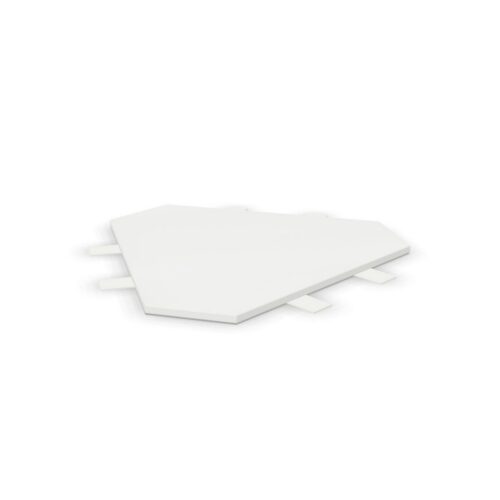


Trigoon table tops describe a distinctive plan shape used on selected workplace tables. The term refers to the outline of the tabletop when viewed from above, rather than its finish, edge profile, base colour or the materials used beneath it.
For procurement teams planning flexible, collaborative or space-conscious layouts, table-top shape is an important practical detail. A Trigoon top can affect how a table sits within a room, how people approach it, the clearance needed around it and the way several tables can be arranged together. Review the dimensions and product images for each listed item, as the precise proportions, base options and intended use vary by model.
What does Trigoon mean for a tabletop?
On this archive, Trigoon is the manufacturer or product-range designation for the tabletop’s plan shape. It identifies the visible working surface geometry, not a separate furniture category. It should therefore be considered alongside the table’s overall width, depth, height, support structure and seating arrangement.
Unlike a standard rectangular top, a shaped top can introduce angled, curved or otherwise non-linear edges to a layout. The particular Trigoon form shown on an individual product page should always be checked before specifying it in a scheme. Drawings, measurements and imagery are useful for confirming orientation, usable surface area and the relationship between the top and its base.
Why tabletop shape matters in workplace planning
A table is more than a surface: it sets boundaries for circulation, conversation and task work. Choosing by top shape can help facilities and design teams compare products that may perform differently in the same floor area. A Trigoon table can be relevant where a conventional straight-sided footprint does not suit the room or the planned furniture arrangement.
- It can help create a more deliberate layout in meeting, touchdown or shared-work areas.
- Its outline may influence how easily users move around corners and between neighbouring furniture.
- The shape can affect where chairs are positioned and how much clear space is needed for access.
- It may support modular-looking arrangements when tables are specified in groups.
- It gives project teams another criterion to use when balancing capacity, circulation and visual consistency.
These considerations are site-specific. The same tabletop shape can work differently in an open-plan office, a compact room or a multi-purpose training area, depending on the table size and surrounding furniture.
Suitable settings for Trigoon table tops
Shaped tables are often considered for spaces that need a less formal or less repetitive furniture plan. They can provide an alternative to rows of rectangular tables while still offering a practical work surface. The right application depends on the product’s dimensions, height and intended function.
Potential settings include collaborative work zones, project rooms, informal meeting points, training environments and reception-adjacent waiting or touchdown spaces. A Trigoon top may also be considered for a meeting room where the layout needs to work around doors, screens, storage or architectural features.
- Collaboration areas: for teams gathering around shared documents, laptops or display material.
- Project spaces: where furniture may need to accommodate changing groups and activities.
- Training rooms: where arrangement and sightlines should be assessed alongside participant numbers.
- Compact meeting rooms: where the table footprint needs to be measured carefully against circulation routes.
- Open-plan workplaces: where a distinctive shape can help define a shared setting without enclosing it.
Table types available with this shape
The Trigoon filter may include tables designed for different workplace uses. Do not assume that every item is a meeting table, a desk or a modular unit solely because it has this top shape. Product specifications will identify the relevant dimensions, configuration and features.
When planning formal group work or client meetings, compare the listed products with the wider range of conference tables. For individual and team workstations, it is also useful to consider the requirements of office desks, including worktop depth, equipment placement and user position. Selecting a top shape is one part of a broader specification process.
How to choose a Trigoon table
Begin with the purpose of the space and the number of people expected to use the table at one time. Then map the product dimensions onto the room plan, allowing for chairs, movement, adjacent furniture and any access requirements. A shaped edge can change the effective clearance compared with a rectangle of similar overall dimensions.
Consider how the table will be used during a typical day. A surface for short discussions may have different requirements from one used for extended laptop work, training materials or shared screens. Check whether the chosen product’s proportions provide usable space in the positions where people will actually sit or stand.
Questions to consider before specifying
- What are the overall tabletop dimensions, and how will its orientation sit in the room?
- How many users need to be accommodated for the intended activity?
- Is there sufficient clearance for chairs, circulation and access around all sides?
- Will laptops, monitors, papers or other equipment reduce the practical working area?
- Does the supporting base allow comfortable legroom in the expected seating positions?
- Will the shape work as a single table, or is it intended to form part of a wider arrangement?
- Do finish, edge and base choices align with the rest of the workplace furniture specification?
Planning layouts and combinations
Where multiple tables are being considered, use scaled plans rather than relying on overall room size alone. The spacing between shaped tops can affect both the visual rhythm of a scheme and the routes available to users. Include chairs in the drawing, particularly where tables are placed near walls, storage, meeting-room doors or presentation equipment.
If tables will be moved or reconfigured, assess the practical handling needs as well as the final layout. Weight, base design and available storage space may influence whether a particular model suits a flexible setting. For fixed arrangements, consistency of top shape can be balanced with the need for different table sizes across rooms.
Related Myntwork table ranges
Use this Trigoon archive to compare products sharing the same tabletop shape, then review each product page for the details needed for a final specification. For larger group settings and boardroom-style layouts, browse the full selection of conference tables. For workstation-led projects, the office desks category provides related options for individual and shared work areas.