


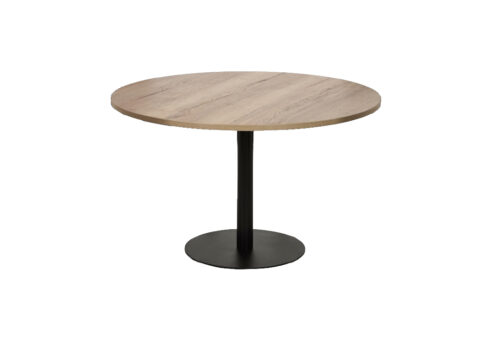
Seat Planning for Stationary Round Leaf Tables
A round perimeter offers different possible seating orientations, so begin with the relationship between participants rather than the walls alone. Decide where people will naturally sit for the usual meeting and check how those positions relate to the entrance. A chair that looks convenient on a drawing may be awkward to approach when neighboring seats are occupied. Work around the tabletop and consider each arrival route in turn. Stationary conference tables with round leaf tops should be assessed as part of an occupied room, with people joining, leaving and moving their chairs during ordinary discussion rather than remaining still throughout the session.
Balance Conversation With Screen Views
A circular tabletop does not guarantee equivalent views of a presentation wall. Some seating positions may require people to turn more than others, depending on how the table is placed. Identify whether discussion or screen use usually leads the meeting, then orient the seating accordingly. If the room supports both, compare how participants change their focus between colleagues and the display. Keep the facilitator's position in that assessment without assuming the round shape automatically removes meeting hierarchy. The most useful arrangement is the one that supports the team's actual exchange of information and makes the necessary changes of attention straightforward.
