







Centering Lounge Furniture With Round Tops and White Surfaces
Identify what the center of the lounge group means in practice. It may be the middle of the seating arrangement, the focus of the arrival view, or a position shared by the principal seats. These points do not always coincide. Place the circular top in relation to the people who will use the group, then review how that position reads within the room. A round outline does not require edge alignment in the same way as a rectangle, but the furniture still needs a deliberate relationship with nearby walls, adjacent groups, and the routes that connect the lounge to surrounding spaces.
Review Seating Around the Circle
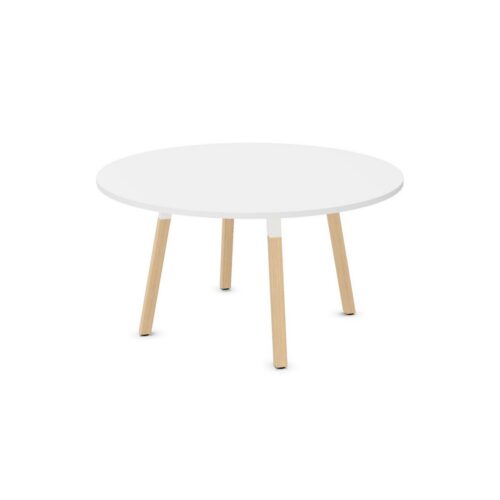
For lounge furniture with round tops and white surfaces, assess the distribution of seats around the perimeter. The circular outline provides no designated end position, so the seating arrangement establishes the group's direction and emphasis. Review how each seat relates to the shared surface rather than assuming that a round top makes every position equivalent. Include the gaps used to enter and leave the group. If the lounge faces a reception point or another room feature, consider how that external focus affects the arrangement. The seating can have a clear direction even when the top itself has no principal axis to follow.
