



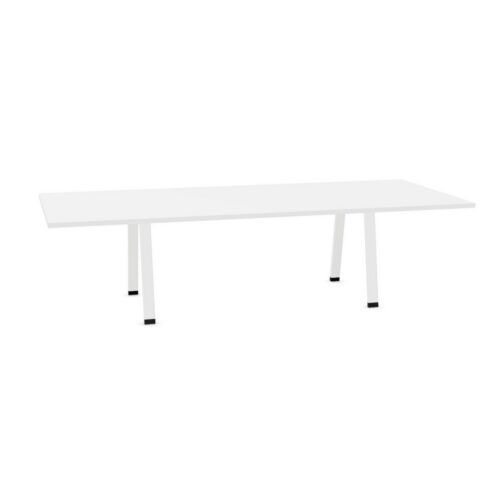


Conference Tables With Round Tops and Grey Surfaces in Shared Rooms
A shared meeting room may host planning discussions, project updates, and document reviews in succession. Begin with the activity that occurs most often. The circular perimeter can support a consistent group arrangement, while individual working habits determine where laptops, notebooks, and shared papers need to sit during each type of session.
Consider whether the same chair positions can serve those activities without repeated changes. A room that alternates between conversation and presentations needs a clear view of both people and the display. Review the relationship from every intended seat, rather than assuming that a round layout gives everyone an equivalent presentation view.
Coordinate Gray Without Requiring an Exact Match
Gray surfaces elsewhere in the room may differ in tone. Compare the tabletop with the floor and nearby storage in the lighting normally used for meetings. Decide whether the relationship should be closely coordinated or visibly distinct. Both approaches can work, provided the choice is intentional within the complete room.
Chair upholstery can provide another point of connection. It may repeat a neutral tone or introduce a separate color around the circular edge. Evaluate this as a group of elements rather than a series of isolated matches. The tabletop's round outline and the arrangement of chairs contribute as much to the composition as color does.
Resolve Door and Storage Access Early
Round conference tables with gray surfaces should be positioned according to the routes people use. Follow the path from the door to the seating area, including the places reached after other participants are already seated. Avoid relying on chairs being pushed in to make the room's essential access routes work.
Next, consider tasks performed during meetings. Opening storage, reaching shared supplies, and approaching presentation equipment may all require movement behind chairs. These routes can influence table placement more than visual centering does. Review them together so that solving access at the doorway does not create a different obstruction elsewhere in the meeting room.
