



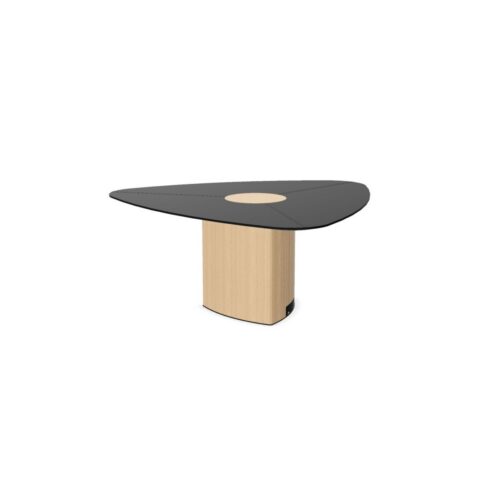




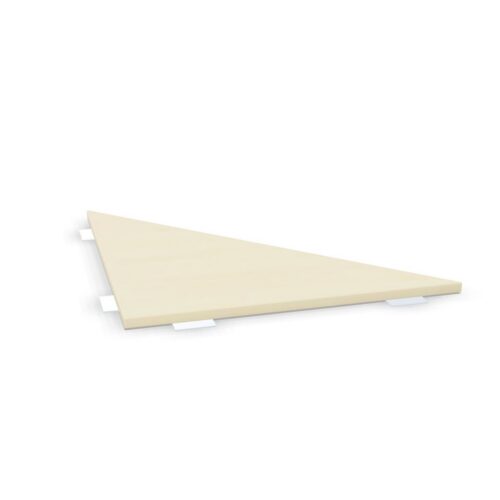


Planning Conference Tables With Trigoon Tops and Grey Surfaces
Gray is a relational color choice: its appearance depends partly on the surfaces around it. Compare the tabletop with the actual floor, seating and walls planned for the room. A collection of similar tones may feel coordinated, but assess whether the table's contour remains visually clear within that composition.
Use the room entrance as one observation point and the intended chairs as others. The view changes when the tabletop becomes the foreground of a meeting. Rather than assuming that all gray elements will work together, decide which should recede and which should remain distinct. This gives the surface color a defined role in the overall arrangement.
Choose an Orientation for Shared-Screen Meetings
Where a wall display is used regularly, make it part of the table-placement decision from the start. Position chairs around the trigoon contour and review the direction each participant would face. The useful arrangement is the one that connects the tabletop activity with the information shown on the wall.
Include moments when attention shifts between the display and the group. Participants should be able to follow both without the arrangement requiring repeated repositioning. Review the route used by someone approaching the display or a writing area. A gray surface can coordinate the setting visually, but the seating and presentation relationship needs its own practical assessment.
