



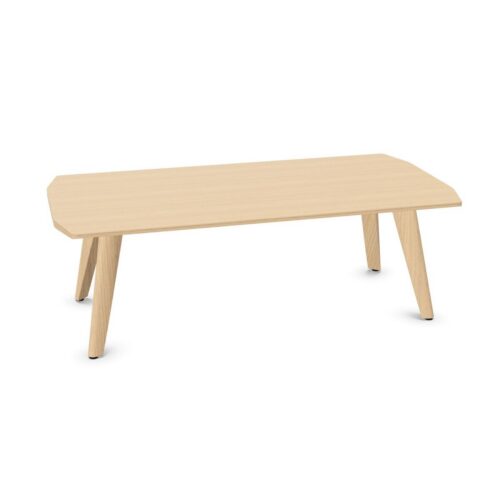
Understanding Lounge Furniture With Trigoon Tops and Wood Surfaces
Confirm the actual trigoon outline before developing the lounge arrangement around it. Review its edges, corners, and overall orientation as separate observations. The name should not be used to infer a precise profile, rounded details, symmetry, or any other characteristic that has not been established for the particular tabletop.
Use an overhead view together with views from the intended seating positions. The plan helps show how the form occupies the arrangement, while seated views reveal its relationship to individual users. Keep both in the discussion so that the decision is based on more than the table's appearance from one angle.
Testing Different Orientations Among Seats
Compare the top in several positions within the same seating group. Keep the seats fixed initially so that the effect of turning or moving the table remains clear. Identify which parts of the outline face the primary seats and which parts meet the approaches into the lounge arrangement.
Review each occupied seat separately. An orientation that looks balanced across the group may relate more closely to one person than another. Check ordinary tabletop use and the route to each place, then assess the arrangement as a whole before deciding whether the table position or the seating relationship needs further adjustment.
