

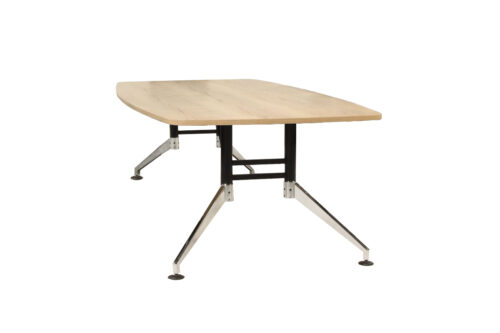
H-Leg Support for Conference Room Layouts

Conference tables with h leg frames call for attention to the relationship between the legs, connecting supports and intended seating positions. The H-leg designation describes the frame arrangement without establishing a material, surface color or adjustment mechanism. Start by examining where the frame sits beneath the tabletop and how that arrangement corresponds to the places people will occupy during meetings.

Consider both the end positions and the seating along the sides. Depending on the actual design, participants may meet different parts of the frame when pulling in a chair or placing their feet. That makes the intended seating plan a useful basis for comparison. Look beyond the table too: the routes behind chairs, access to the entrance and movement toward a screen or whiteboard all contribute to whether the H-leg arrangement suits the room’s everyday purpose.

6 models
From €138.70 p/m
4 models
From €100.49 p/m
6 models
From €138.70 p/m
6 models
From €97.71 p/m
6 models
From €4.57 p/m
€16.17 p/m

Chair Alignment at Conference Tables With H Leg Frames

Use the intended chairs to assess where regular seating positions should fall. Compare each position with the legs and connecting parts of the frame. A visually even arrangement of chairs is not necessarily the most practical arrangement if a support occupies the area a participant needs beneath the table.

Check the movement from standing to sitting, then from a relaxed position to leaning into a discussion. People may move their feet and chairs as the meeting changes pace. Assessing these ordinary actions helps establish whether the proposed positions work with the actual H-leg layout.

Giving End Positions Their Own Assessment

Do not judge the entire seating arrangement from the long sides alone. End positions can have a different relationship with the frame and deserve a separate review. Consider whether these seats will be used regularly, reserved for occasional participants or left out of the everyday room arrangement.

If someone commonly leads meetings from an end position, include their usual activities in the check. They may turn toward a display, spread out papers or stand to use a writing area. The relevant question is whether the position supports that routine without the frame creating an awkward seating relationship.

Coordinating Support Lines With the Interior

Conference tables with h leg frames introduce a recognizable support arrangement beneath the surface. Look at how its lines relate to chair frames and nearby furniture. From some viewpoints the structure may be prominent; from others, seating may partially obscure it. Assess the table within the room rather than in isolation.

Keep appearance separate from unsupported functional assumptions. An H-leg frame does not establish a particular level of stability, an adjustment feature or a material. If any of those matters is important to your workplace, assess it independently rather than treating the frame's visual form as evidence.

Preserving Access During Different Meeting Activities

Map the route between the entrance, seating and shared presentation areas. Include chairs pulled back from the table and the paths people use to reach places farther into the room. The frame arrangement is part of the furniture decision, while circulation depends on the complete room plan.

For presentation sessions, consider participants turning toward a shared view. For collaborative discussions, consider movement between seats and a whiteboard. Review whether the same arrangement can serve both activities. If table movement is necessary, confirm mobility separately; the H-leg designation does not answer that question.

Frequently Asked Questions

Where should the frame be checked against seating?

Check every intended seating area, with particular attention to positions beside legs or connecting supports. Conference tables with h leg frames should be assessed using the actual chair arrangement, since different positions can relate differently to the structure.

Does an H-leg frame establish height adjustment?

No. The designation identifies the frame arrangement. It does not confirm whether the table has a fixed working level or an adjustment mechanism. Review working-height requirements separately from the decision about the H-leg form.

Can the frame determine where the meeting leader sits?

It can influence which positions are practical, but it does not prescribe a meeting layout. Check the leader's usual tasks, sightline to presentations and access to shared room features before choosing a regular place.

Explore related selections